CHANGING ATTITUDES AND BEHAVIOURS
 Spending a morning with the TV stream has demonstrated that change is possible. Last year at the Communication and Media Advisory in Lasko, Slovenia, TV producers agreed the need to share resources – particularly across language groups. Twelve months on there has been some limited success, the primary example being the use of British Adventist Olympic coverage of the German Hope Channel.
A presentation by German Hope Channel on a collaborative project based around the book of Revelation brought open support and positive discussion. Expect to see 'Open Secret' on your screen sometime in 2014 – and hopefully in your own language.
If ten studios across Europe each led in a project like this once every five years this could lead to a significant quality increase across all Adventist channels.
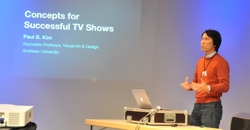 In the final TV stream of the morning, Paul Kim, Associate Professor of Documentary film at Andrews University asked the hard questions on who our audience is and how we gain it. He demonstrated the power a popular programme can have by showing how when a character from 'Happy Days' joined a public library there was a 500% increase in library tickets (in the USA). Most Adventist producers, he states, do not know who their audience is. That is important.
Paul equally demonstrated that 'edutainment' works in the secular world. Programmes like 'Friends' and ER actually share information and help the audience to open up. Can Adventists do the same?
Documentaries, in particular, he says, can help social change. Showing 'I care' in a documentary can lead to care and change of attitude in the real world. It also has to be entertaining - emotionally engaging and compelling. "That's what great story telling is," Paul argued, adding, "Let's admit it, the best preachers in our church are entertaining!" The preacher may have good content, but if his delivery is poor his message is lost. The same it true for TV.
Adventist TV may be changing! Keep an eye on your local channel.
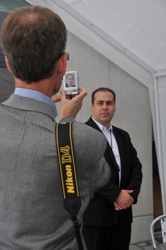 You can be a photographer, but to be a photo-journalist you have to let your photo tell a story. In simple language, passionate photographer, Tor Tjernansen, encouraged budding photographers to "look for the verb in the story". It may take 50 shots to get it, but a boy kicking a football is far more interesting than a boy and a football.
  Tor's workshop followed a serious emphaisis on good photography in Monday's e-news track. Both Ansel Oliver (ANN News Editor) and Victor Hulbert (British Union Communication and Media Director) showed in simple terms how to take a good photo and use it in a news story. The aim of
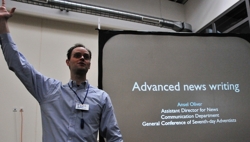 What do you tell 40 media professionals in a workshop on newswriting. For Ansel Oliver it is simple, "Go in deeper"